At this point of maxxximum intersection of meme and reality, where Instagram meme pages start Substack newsletters and become media brands, is there even a difference between telling a story and making a meme? And if memes are built on remix, anonymity, and speed, what does it even mean to make original content online?
Kristin Merrilees is an internet culture writer, journalist, and meme maker. In her newsletter PHONE TIME and her social media practice, she moves between reporting and meme-making as two symbiotic forms. In a moment when trust in legacy media is collapsing and newsfluencers, Substackers, and TikTokers are filling the gap, the line between journalist and content creator between making a meme and breaking a story it might not exist at all.
Here you can find the Q&A through email with Kristin about being an original content online; the blurry line between researching and scrolling; what a meme can say that a sentence can’t; and what journalism and meme-making are still teaching each other.1. Let’s start from the basics: how does it feels to be an internet culture reporter?
It’s a dream in many ways! As a reporter, it’s your job to spend your days talking to people and learning new things. I love doing stories that are a little offbeat or that haven’t been touched by legacy outlets. So I spend a lot of time on my Instagram Explore page, on the Wayback Machine, and reaching out to people about their online projects.
Both the beauty and the challenge of internet culture reporting is that it’s kind of
all-encompassing, so you get to learn about so many different worlds. I’ve reported stories that have touched food, fashion, business, art, and media. I think the job of reporting also just makes you a better person. People letting you into their worlds opens up your own; you become more empathetic. It’s also often quite challenging. It’s super time-intensive and resources are usually quite limited (and getting more so). Journalism has always been a tough business, but there’s a really unique set of challenges right now. Even so, there’s a lot of solidarity in the industry, especially amongst early career people, which gives me hope.
2. You’ve described your work as being at the intersection of journalism and meme-making. Where does being online end and researching online begin? Is there even a line?
This is a good and funny question, because I’ve heard so many people whose job is “the internet” in some capacity talk about how the work just seeps into every aspect of their lives. If there’s a line, I certainly haven’t found it. If your job is to study online communities and platforms, that’s kind of going to be background noise whenever you log on, even if you’re not trying to consciously think about it. Even if I’m going on a walk and am not checking my phone, I’ll see a funny sign or something and almost subconsciously be like, “Oh, that could be a tweet! That could be a meme!”
Most of the time I spend online is probably for fun, brainstorming, or saving things to come backto later. If I’m making memes, it’s usually in this more scattered or spontaneous state. When I know I want to research something more thoroughly, then I’ll start being more intentional—annotating longform articles, seeing what reporting or academic research is already out there, writing things down in a Google doc.
I am completely fine with not having a pulse on absolutely everything. There are so many things happening online, it’s just impossible to keep up with it all. Plus, I think if you’re trying to chase every trend, you’ll just exhaust yourself and you won’t have any time leftover to be creative in your own thinking, writing, and reporting.
3. In ‘How it feels to be an internet culture reporter’ you told the story of your work entirely through memes you made yourself. What can a meme say that everything else can’t?Memes let you combine images and text in really creative and surprising ways—and because of the nature of the format, the images can come from anywhere: TV shows, stock photos, actual photos you took, screenshots, works by artists, even simple text-on-background as Instagram’s Create Mode makes easy. Because the basic format can be as simple or as elaborate as you want it to be, you can remix, change, or add to others’ memes super quickly. I think because the process is so accessible, one format can end up going in so many different directions.
Personally, if I were to contrast the memes I make to my other work, I think the memes allow for observations (I talk a little about this in Q4) that are smaller in scale but still (I hope?) interesting.In comparison to journalism, they can be more speculative, opinionated, sarcastic, and subjective. I studied zines in school and have also reported on them, and I noticed that brands—like Cash App and Hinge—have started releasing what they’re calling “zines.” I made the below meme about that phenomenon, which I think was a good format to illustrate my thoughts in a bit of a sharper way.
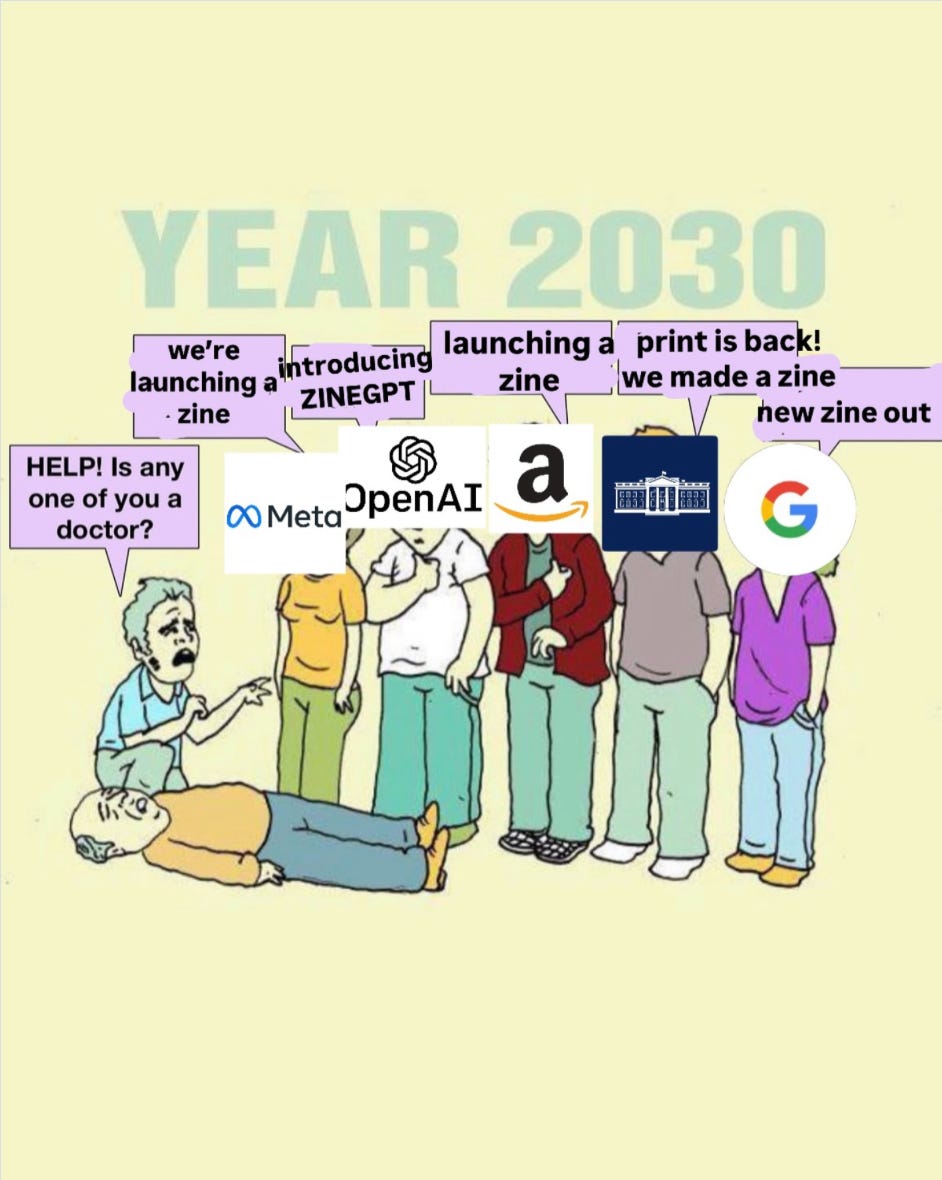
4. At this point of maxxximum intersection of meme and reality, where Instagram meme pages start Substack newsletters and become media brands, is there even a difference between telling a story and making a meme?
I think there’s definitely still a difference in mediums—a journalistic profile is different from a meme, which is different from an academic paper or critical essay. But I think as you mention, one thing (a meme page) can now become much more (a media brand). I gave a short talk about this relating to feminist media this past winter. As many feminist outlets, like Bitch, The Toast, and The Hairpin have shut down, a lot of smaller online projects that fall somewhere between meme page, magazine, online publication, and podcast have emerged.
Examples I’ve reported on include Daughter Zine, Material Grrrlz, and everyone is a girl. Podcasts like Binchtopia, Dewy Dudes, Nymphet Alumni, and Throwing Fits also have Instagram pages where they post a lot of memes.
4. Journalism has traditionally been about verification, attribution, and original reporting. Memes are built on remix, anonymity, and speed. You work in both. How does your journalism practice affect your meme-making?
I think of journalism and meme-making as two different practices that, for me, are actually symbiotic! As a journalist, I’m constantly looking for things that could be a story. Some are generally straightforward—a cool person, upcoming event, weird TikTok trend. But a lot of them are less tangible and come from me sharpening my observation skills over the years. Finding something and thinking “Hey, what’s up with that? That’s kind of weird...” and then looking into it. Coming up with ideas for memes is actually surprisingly similar. A good piece of trend or enterprise reporting will make clear something that’s been bubbling up under the surface, something ordinary even. You actually want a response that’s like “I’ve been thinking or experiencing this too, but never thought to put it in this way.” I think memes can do a similar thing.
The kind of depth that a journalistic story requires also helps me understand nuances which might make for interesting memes. I take a ton of photos IRL, often to remember or document something I might want to report on, but a lot of those photos end up in my memes. I do keep the formats pretty separate, because of the differences between the two mediums you describe. I don’t directly include any of my reporting in my memes, and I think I’m generally pretty traditional journalism-wise in how I write my stories. But there’s a lot of conversation about how to bring news to audiences in more creative, engaging ways, so it’s possible I’ll explore that in the future.
5. What is an ‘original content online’? In our algorithmical age, what does it even mean?
Yeah, the word “original” I think is similar to “authentic” in that what we mean by it is often kind of fuzzy. I think there are probably people in academia or the art world who have thought about this in a lot more depth, but I kind of return to how it’s used in both journalism and meme making. I think it’s also okay for it to be defined differently across different making and knowledge practices.
In journalism, the gold standard is “original reporting.” So getting someone on the phone, doing an in-person interview, or otherwise getting information that other people don’t have, maybe by obtaining a government record or an internal company email. That’s not to say that everything is original reporting (even flagship newsrooms publish a ton of aggregated or listicle-type content), but publications (and individual journalists) live and die by their original reporting. Also, even though criticism usually doesn’t include interviews, a good piece of critical writing produces fresh perspectives because of the authority and knowledge the critic has built up over time.
In meme-making, sometimes people will write something like “all oc” in their bio, meaning original content. What that means exactly might vary to different people. I understand it as the main blocks or elements (text and images) of the meme were added by the poster, even if they’re using a previous template or drawing from other sources. Instagram has guidelines on “original content,” but it’s still kind of fuzzy where memes fit in.
6. You write that copying, often with modification, is integral to meme culture and that as a meme maker yourself, you get irritated when your memes are reposted without credit, even though many of them are remixes of others’ content. How do you think about originality when the medium is built on repetition and propagation?
Yeah, I do sometimes get irritated! But mostly when it’s kind of an obvious thing—similar to how I feel when a page reposts a screenshot of my tweet but crops my name out. Even in that kind of situation, I kind of shrug my shoulders. I could watermark with my username if I wanted to, but I don’t. And sometimes my memes end up traveling really far, which is always funny and cool to see. I’ve talked to a few other meme creators about this. I think people have varying opinions but generally agree that it’s good practice to credit by tagging as much as you can. A lot of memes are increasingly elaborate and made by people with more sophisticated design or art skills. In those cases, I think it’s especially important to consider how much work someone put into making a specific meme before reposting or altering.
I’m more frustrated with a general online ecosystem that often incentivizes against taking the time and resources necessary to make original content. It’s usually much easier to amass a platform quickly by aggregating. I think a lot of journalists are frustrated with this reality.
News aggregators—whether they be individuals, sometimes called “newsfluencers,” or companies—aren’t new (and there’s a lot of aggregation work in traditional newsrooms too), but they have kind of taken on a new life. But what can end up happening is a story will be repackaged and shared so many times that the original work can end up kind of fizzling out in the information ecosystem. I’ve seen comments on TikToks that are like “The media isn’t covering this!” when the person in the TikTok is literally reading from an article reported—sometimes painstakingly—by an established media outlet.
7. There’s a theory that the meme has replaced the article as the primary unit of cultural commentary online. Do you agree? And if so, what does that mean for journalism - and so for you?
For cultural criticism or commentary, I definitely think the meme (and short-form content in general—TikToks, Instagram Reels) is playing an increasingly significant role. Memes can also point to works of cultural criticism, theory, or philosophy both big and small, but sometimes in a simplified or reductive way. Part of my undergrad thesis research explored this in the context of “girlhood” memes. Another example might be how in the “performative male” memes, “Infinite Jest” is more about the man reading it than the book itself.
I think it’s a bit more complicated than one replacing the other; rather, there’s a constant interplay between meme culture and journalism. Maybe one example of this is celebrity lookalike contests. The Timothée Chalamet lookalike contest was designed to become a meme from the beginning. You had these amateur-looking posters stuck up around NYC that everyone then started posting on Twitter and social media. Besides a Partiful, there weren’t really any other details, and the organizer—who I remember originally just identified himself as “Gilbert”—wasn’t talking to press in the days leading up (which of course, makes us itch more to figure something out).
I remember finally getting hold of him the day of for a story I was co-reporting, and it turned out he was Anthony Po, who had done viral stunts in the past—including getting hundreds of people to watch him eat cheeseballs in a park—and just has an absolute talent for commanding attention. I remember feeling a bit foolish as a journalist for basically falling for media bait.
But that event got an overwhelming amount of press coverage, which helped fuel the “lookalike contest” as a meme format, and then there were a bunch of other lookalike competitions, which also got press coverage. So we’re in this weird world where journalism is both functioning within the meme landscape while also trying to report on it. And because reporting is just by nature slower, it will always be playing this game of catch up.
8. Last one: how would you describe the contemporary culture sector in just memes/images?
Some memes of mine!